 |
The new standard.
With the development of the GRUENSCH CSE II second edition stereo power amplifier second edition, our aim was to realize an audio concept that enhances the expression, the power and emotion of music.
Through a holistic view of the extremely complex task of reproducing music the way it should sound, all of the technical characteristics required were defined and turned into a unique audio concept.
|
THE POWERSUPPLY.
For the stereo power amplifier GRUENSCH CSE II second edition, a pioneering power supply was created in terms of effort, technical and tonal features.
 Conventional power supplies, which are essentially only composed of a power transformer, rectifier and smoothing capacitors, take their energy from the public electricity network in the form of short, very high and steep current pulses. These current pulses have a wide distortion spectrum with high amplitudes, which are overlaid via the supply voltage to the music signal of the amplifier, and reach other devices in the audio chain through the mains voltage.
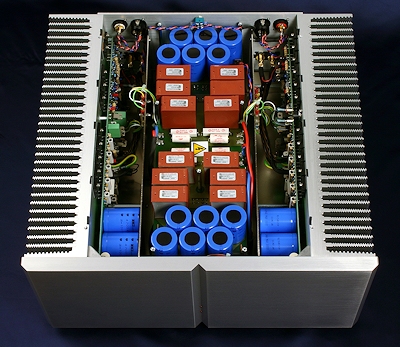
The power supply of the stereo amplifier CSE II second edition, however, is designed as a special choke power supply in a secondary-side dual mono construction.
A line filter, 800VA- toroidal transformer with temperature switch, rectifier, 12 iron powder high-frequency toroidal chokes and long life capacitors, with a total capacity of 120 000 µF / 100V (!) provide an unshakable foundation for the audio section.
The power supply of the stereo amplifier CSE II second edition, however, is designed as a special choke power supply in a secondary-side dual mono construction.
A line filter, 800VA- toroidal transformer with temperature switch, rectifier, 12 iron powder high-frequency toroidal chokes and long life capacitors, with a total capacity of 120 000 µF / 100V (!) provide an unshakable foundation for the audio section.
The benefit of this special choke power supply is that the current drawn from the grid is not taken with high, very steep edges as usual, but with strongly flattened and dampened current pulses instead.
In contrast to conventional power supplies, this makes for an exceptionally low distortion power supply, which does not produce steep current pulses in the network voltage and, thus, no high and “hard” distortion voltage that might otherwise enter other devices in the system through the network voltage - resulting in a "hard" and unnatural sound.
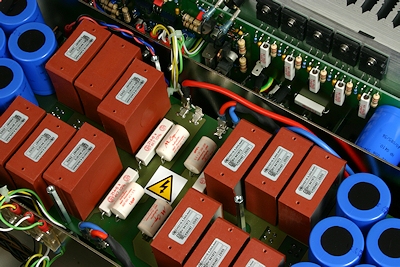 At the same time, the power iron powder toroidal inductors act as a filter network, in a frequency range from below 50 Hz to well above 100 kHz. The subsequent frequency range up to 30 MHz covers the shielded RF power input filter, in which fuses and power switches are integrated as well.
This results in perfect current and voltage purification over the entire frequency range up to 30 MHz.
A switch-on automatic prevents inrush current and switches on the power unit gently. The exclusive use of long-life electrolytic capacitors, as well as the constant low temperature due to the complex high-performance heat sinks that are also inside the unit, guarantee an extremely long life for the power amplifier.
The new circuit design of the stereo power amplifier GRUENSCH CSE II second edition made it possible to create an audio amplifier with ideal technical and tonal characteristics, in a combination that has so far been unprecedented.
In the stereo power amplifier GRUENSCH CSE II second edition, the principal advantages of an outstanding tube amplifier were combined with the advantages of the best transistor amplifiers, without their specific disadvantages.
 In the entire signal path only MOSFETs are used, whose characteristics largely correspond to those of a tube, and can practically be used as tubes.
A particularly powerful, fully discrete single-ended Pure Class A input amplifier operates in the ideal, pure Class A mode and directly controls the 10 strictly hand-selected MOSFET output transistors, i.e. without any driver stage.
In contrast to conventional amplifier circuits in which additional amplifier stages inevitably affect the signal, with this two-stage concept signal distorting driver stages can be avoided.
The exceptional quality of the amplifier concept makes it possible to realise the audio circuit without global negative feedback.
The fully discrete, DC coupled circuit structure is characterized by the consistent absence of ICs, inductors, capacitors and relay contacts in the signal path.
The direct signal path continues in consistent electrical construction. Thus, for example, one half of the total capacity is located in the immediate vicinity of the field effect transistors of the amplifier section. This results in a perfect energy flow, which guarantees ultra-fast and explosive energy development.
This circuit concept allows for technical and tonal characteristics that effectively embody the ideal of the oft-cited "amplifying piece of wire". This will be explained in more detail below.
TECHNICAL AND TONAL CHARACTERISTICS.
(For a compilation of all technical data see Technical Data)
Since all the technical characteristics of an audio amplifier are in direct connection with each other and sometimes even contradict each other, it was essential to consider these holistically and in context. With the development of a novel audio concept, it was possible to bring all the properties required for a lifelike music reproduction together and to consistently bring them to the highest level over the entire audio range, thereby creating the conditions for natural music reproduction.
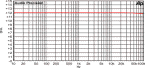
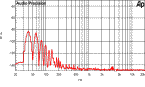
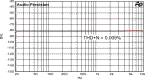
The high damping factor of the stereo power amplifier CSE II second edition, resulting from the very low internal resistance, extends over the entire audio frequency range with extreme linearity (Fig. 1).
Due to the excellent phase position of the internal resistance, unnatural phase shifts of the music signals are kept extremely low.
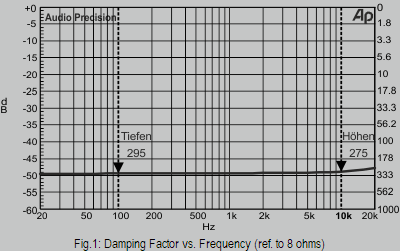 Since the internal resistance is almost independent of frequency and therefore is not capacitive but purely resistive at high frequencies, the amplifier behaves like a piece of wire and is thus extremely stable with a complex load (loudspeaker). In addition, parasitic cable oscillations that occur in the oscillating circuit of loudspeaker, crossover and speaker cable are effectively dampened.
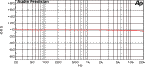
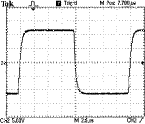
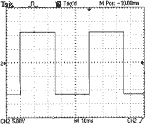
Because of the enormous "speed" of the audio circuit, expressed in a rise time of 0.9 microseconds and a frequency bandwidth of 0.2 Hz - 400 kHz (-3 dB), all harmonic oscillations and spatial information of the music signal can be reproduced, especially from vinyl records and high resolution digital formats.
 This outstanding technical features, unprecedented in this particular combination, are complemented by a harmonious and natural distortion performance.
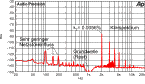
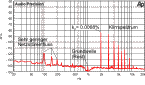
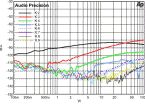
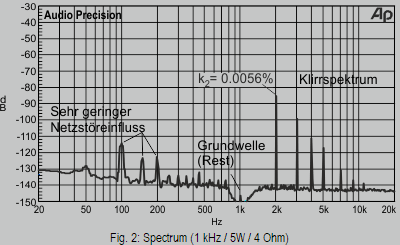
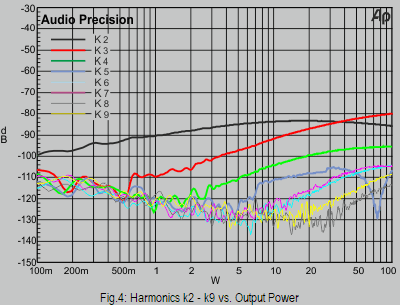
The distortion spectrum with the ideally dominant harmonic k2 falls quickly and harmonically (k2> k3> k4, etc.) and shows no higher-frequency harmonics> k9 (Fig. 2).
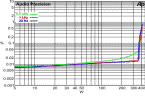
Despite the deliberate decision against global negative feedback, this nearly ideal distortion spectrum is extremely low (THD+N 0.009% at 25W/ 4 ohms). In addition, no "electromagnetic interference" between the harmonics is visible. The power line interference is also exceptionally low (<115 dB) and narrow-banded and the noise floor is extremely low.
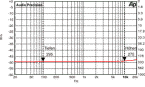
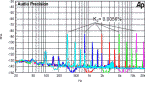
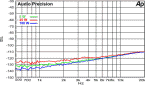
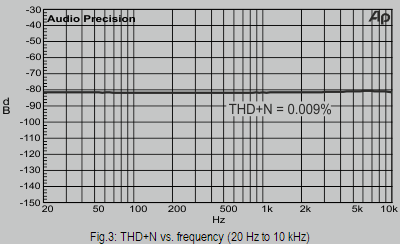 The outstanding feature of this amplifier concept, however, is that this ideal distortion spectrum shows consistency in the form and amount over the entire frequency range of the music, not just at a certain frequency (Fig. 3).
In contrast to traditional approaches, the distortions at higher frequencies do not rise and instead remain consistently low, "soft" and harmonious at all frequencies.
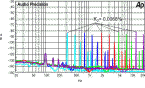
The analysis of the harmonics k2 to k9 on output power shows ideal musical distributed harmonics k2 to k9 with perfect gradation. All distortion harmonics increase consistently and proportionally with output power (Fig. 4).
 Despite its enormous speed, the concept is distinguished by its excellent stability in particular. Thus, the stereo power amplifier GRUENSCH CSE II second edition is destined to make full use of the potential capacitive loudspeaker, such as the way it presents electrostatic speakers for example.
Together with the high performance potential and high current capability, the electrical stability allows the sovereign and unlimited operation of even the most critical speaker systems.
The stereo power amplifier GRUENSCH CSE II second edition combines these properties to an audiophile concept that allows you to experience music in its full authenticity.
CUSTOMIZATION OF INPUT IMPEDANCE.
The stereo power amplifier GRUENSCH CSE II second edition provides a unique opportunity to choose the input impedance in 3 levels (30 kOhms, 5 kOhms, 600 Ohms).
In this way, for all combinations of preamplifier, interconnects and power amplifier, the best setting for lossless transmission can be selected.
GRUENSCH- audio components are handcrafted with the utmost care like a musical instrument in the tradition of finest craftsmanship.
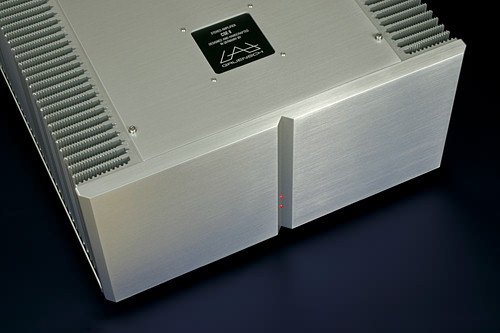
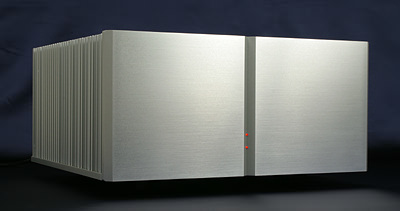
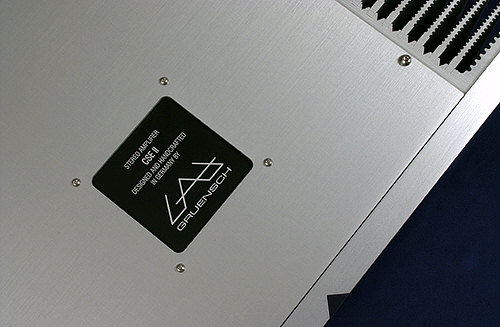 The stereo power amplifier GRUENSCH CSE II second edition provides the owner with a sense of absolute quality and solidity. Through consciously sticking to the essentials, it stands out from other audio components with its simple elegance. In addition to its extremely careful manufacturing, the casing design also features excellent tactile quality.
The extremely solid front panel of the housing is made of 20 mm thick, brushed aluminium. All housing components, including the high-performance heat sinks, are also pickled and permanently finished by hard anodizing. The velvety silvery shine conveys the pure, natural beauty of the aluminium material.
The entire casing rests on special supports made of several materials. The extremely solid cabinet construction counteracts possible transmission of vibrations from airborne sound. Even the high-performance heat sinks are dampened through special neoprene aluminium angles.
The electrical structure of the stereo amplifier GRUENSCH CSE II second edition was designed particularly uncompromisingly and consistently.
The strict separation of power supply and audio electronics by means of massive, copper-plated and nickel-plated steel sheets, a sophisticated grounding including central mass star point and a sophisticated PCB design can achieve an unmatched channel separation and an exceptionally high signal to noise ratio with this stereo power amplifier.
This ensures that the most nuanced musical details are not obscured, providing an excellent spatial imaging.
PROTECTIVE EQUIPMENT AND ELECTRICAL SAFETY.
The VDE and CE-compliant design meets the highest safety standards.
In addition, the stereo power amplifier GRUENSCH CSE II second edition has a number of very reliable protective devices that guarantee maximum safety and durability of its electronics. To avoid inrush and thereby to protect the components, a switch-on automatic loads the enormous power supply capacity (120000μF / 100V) gently over a temperature-controlled high-power resistor.
A current limiter not in the signal path with delayed separation from the power supply protects the amplifier and the connected loudspeaker system in the case of short-circuiting or overload.
In addition, other protective circuits ensure that the amplifier is switched off in the case of DC voltage, over-temperature or high frequency oscillation.
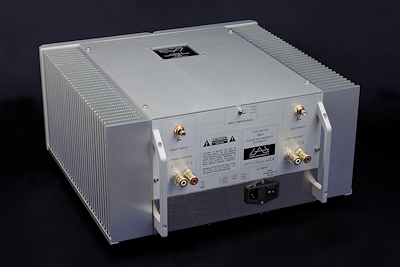 For the loudspeaker system’s connection, the stereo power amplifier CSE II second edition has high quality WBT Nextgen speaker terminals.
The connection to the preamplifier is carried out unbalanced via gold-plated Furutech RCA-type sockets.
In addition to the main power switch on the rear panel, the stereo amplifier GRUENSCH CSE II second edition can also be switched on and off via an easily accessible front-sided switch on the ground plate.
TECHNICAL SPECIFICATIONS GRUENSCH CSE II second edition - Typical Values
Click here or directly on the diagrams to enlarge.
|
|